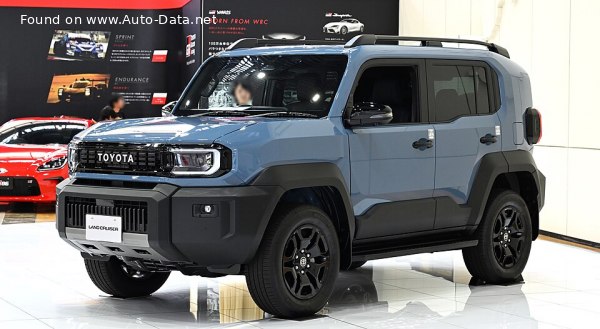
Home › Car catalog › Toyota › Land Cruiser FJ › Land Cruiser FJ › 2.7 (166 Hp) 4WD Automatic

ToyotaToyota Land Cruiser FJ 2.7 (166 Hp) 4WD Automatic2026: specs, Fuel consumption, Dimensions

2026 Toyota Land Cruiser FJ - Photo 1
Toyota Land Cruiser FJ - Photo 2Toyota Land Cruiser FJ - Photo 3

Key specs

Toyota Land Cruiser FJ 2.7 (166 Hp) 4WD Automatic /SUV 2026 - /
What is the body type of Toyota Land Cruiser FJ?
SUV, 5 Doors, 5 Seats
What is the fuel consumption and economy of Toyota Land Cruiser FJ 2.7 (166 Hp) 4WD Automatic?
11.3 l/100 km
20.8 US mpg
25 UK mpg
8.8 km/l
What is the power output of Toyota Land Cruiser FJ SUV 2026 2.7 (166 Hp) 4WD Automatic?
166 Hp, 245 Nm
181 lb.-ft.
What is the engine displacement of Toyota Land Cruiser FJ SUV 2026 2.7 (166 Hp) 4WD Automatic?
2.7 l
2694 cm3
164.4 cu. in.
What is the number of cylinders in 2026 Toyota 2.7 (166 Hp) 4WD Automatic?
4, Inline
What is the drivetrain of Toyota Land Cruiser FJ SUV 2026 2.7 (166 Hp) 4WD Automatic?
All wheel drive (4x4). ICE. The Internal combustion engine (ICE) drives the rear wheels permanently, and the front wheels are driven through an electrically or mechanically operated clutch if necessary.
What is the length of 2026 Toyota Land Cruiser FJ SUV?
4610 mm
181.5 in.
What is the width of 2026 Toyota Land Cruiser FJ SUV?
1855 mm
73.03 in.
What is the kerb weight of 2026 Toyota Land Cruiser FJ 2.7 (166 Hp) 4WD Automatic?
2005 kg
4420 lbs.
What is the maximum permissible mass of 2026 Toyota Land Cruiser FJ 2.7 (166 Hp) 4WD Automatic?
2500 kg
5512 lbs.
What are the number of gears and the gearbox type of 2026 Toyota Land Cruiser FJ 2.7 (166 Hp) 4WD Automatic?
6, automatic transmission
Toyota Land Cruiser FJ 2.7 (166 Hp) 4WD Automatic
Compare

General information

Brand
Generation
Modification (Engine)
2.7 (166 Hp) 4WD Automatic
Start of production
February, 2026
Powertrain Architecture
Internal Combustion engine
Body type
SUV (Sport Utility Vehicle)
Seats
5
Doors
5
Looking for Toyota Land Cruiser FJ on the used-car market?
Check its history →

Performance specs

Fuel consumption (economy) - urban
14.4 l/100 km 16.3 US mpg
19.6 UK mpg
6.9 km/l
Fuel consumption (economy) - extra urban
9.5 l/100 km 24.8 US mpg
29.7 UK mpg
10.5 km/l
Fuel consumption (economy) - combined
11.3 l/100 km 20.8 US mpg
25 UK mpg
8.8 km/l
Fuel Type
Petrol (Gasoline)
Weight-to-power ratio
12.1 kg/Hp, 82.8 Hp/tonne
Weight-to-torque ratio
8.2 kg/Nm, 122.2 Nm/tonne

Engine specs

Power
166 Hp @ 5200 rpm.
Power per litre
61.6 Hp/l
Torque
245 Nm @ 4000 rpm. 181 lb.-ft. @ 4000 rpm.
Engine layout
Front, Longitudinal
Engine Model/Code
2TR-FE
Engine displacement
2694 cm3 164.4 cu. in.
Number of cylinders
4
Engine configuration
Inline
Number of valves per cylinder
4
Fuel injection system
Multi-port manifold injection
Engine aspiration
Naturally aspirated engine
Engine systems
Start & Stop System

Volume and weights

Kerb Weight
2005 kg 4420 lbs.
Max. weight
2500 kg 5512 lbs.
Max load
495 kg 1091 lbs.

Dimensions

Length
4610 mm 181.5 in.
Width
1855 mm 73.03 in.
Height
1950 mm 76.77 in.
Wheelbase
2580 mm 101.57 in.
Ride height (ground clearance)
245 mm 9.65 in.
Minimum turning circle (turning diameter)
11 m 36.09 ft.
Approach angle
29°
Departure angle
38°

Drivetrain, brakes and suspension specs

Drivetrain Architecture
The Internal combustion engine (ICE) drives the rear wheels permanently, and the front wheels are driven through an electrically or mechanically operated clutch if necessary.
Drive wheel
All wheel drive (4x4)
Number of gears and type of gearbox
6 gears, automatic transmission
Front suspension
Double wishbone
Rear suspension
Rigid axle suspension
Front brakes
Ventilated discs
Rear brakes
Ventilated discs
Assisting systems
ABS (Anti-lock braking system)
Steering type
Steering rack and pinion
Power steering
Electric Steering
Tire size
265/60 R18
Wheel rim size
18