Home >> Autocatalog >> Ford >> Ranger >> Ranger II Super Cab >> 3.0 TDCi (156 Hp)
Autocatalog Blog Login Register Car Specs API
English ▼

Specs of Ford Ranger II Super Cab 3.0 TDCi (156 Hp) /2006, 2007, 2008, 2009, 2010/

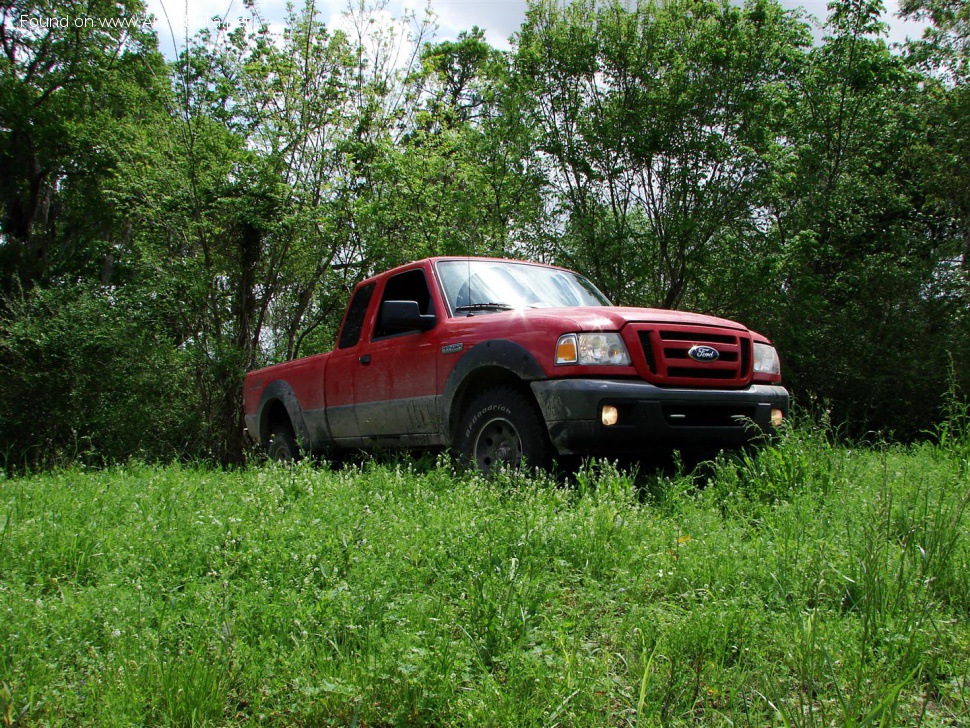
2006 Ford Ranger II Super Cab - Photo 1

Key specs

Ford Ranger II Super Cab 3.0 TDCi (156 Hp) /Pick-up 2006 - 2010/

What is the body type of Ford Ranger II Super Cab?
Pick-up, 2 Doors, 4 Seats
What is the fuel consumption and economy of Ford Ranger II Super Cab 3.0 TDCi (156 Hp)?
10.2 l/100 km
23.1 US mpg
27.7 UK mpg
9.8 km/l
How environmentally friendly is Ford Ranger 3.0 TDCi (156 Hp)?
Euro 4
How fast is 2006 Ranger II Super Cab 3.0 TDCi (156 Hp)?
170 km/h | 106 mph
0-100 km/h: 13.6 sec
0-60 mph: 12.9 sec
What is the power output of Ford Ranger Pick-up 2006 3.0 TDCi (156 Hp)?
156 Hp, 380 Nm
280 lb.-ft.
What is the engine displacement of Ford Ranger Pick-up 2006 3.0 TDCi (156 Hp)?
3.0 l
2953 cm3
180.2 cu. in.
What is the number of cylinders in 2006 Ford 3.0 TDCi (156 Hp)?
4, Inline
What is the drivetrain of Ford Ranger II Super Cab Pick-up 2006 3.0 TDCi (156 Hp)?
Rear wheel drive. Internal Combustion engine. The Internal combustion engine (ICE) drives the rear wheels of the vehicle.
What is the length of 2006 Ford Ranger Pick-up?
5075 mm
199.8 in.
What is the width of 2006 Ford Ranger Pick-up?
1805 mm
71.06 in.
What is the kerb weight of 2006 Ford Ranger II Super Cab 3.0 TDCi (156 Hp)?
1802 kg
3973 lbs.
What is the trunk (boot) capacity of 2006 Ford Ranger Pick-up?
1500 l
53 cu. ft.
What is the number of gears in What is the gearbox type of 2006 Ford Ranger II Super Cab 3.0 TDCi (156 Hp)?
5, manual transmission

General information

Brand
Model
Modification (Engine)
3.0 TDCi (156 Hp)
Start of production
2006 year
End of production
2010 year
Powertrain Architecture
Internal Combustion engine
Body type
Pick-up
Seats
4
Doors
2
Looking for Ford Ranger on the used-car market?
Check its history →

Performance specs

Fuel consumption (economy) - urban
12.6 l/100 km 18.7 US mpg
22.4 UK mpg
7.9 km/l
Fuel consumption (economy) - extra urban
8.9 l/100 km 26.4 US mpg
31.7 UK mpg
11.2 km/l
Fuel consumption (economy) - combined
10.2 l/100 km 23.1 US mpg
27.7 UK mpg
9.8 km/l
Fuel Type
Diesel
Acceleration 0 - 100 km/h
13.6 sec
Acceleration 0 - 62 mph
13.6 sec
Acceleration 0 - 60 mph (Calculated by Auto-Data.net)
12.9 sec
Maximum speed
170 km/h 106 mph
Emission standard
Euro 4
Weight-to-power ratio
11.6 kg/Hp, 86.6 Hp/tonne
Weight-to-torque ratio
4.7 kg/Nm, 210.9 Nm/tonne

Engine specs

Power
156 Hp @ 3200 rpm.
Power per litre
52.8 Hp/l
Torque
380 Nm @ 1800 rpm. 280 lb.-ft. @ 1800 rpm.
Engine layout
Front, Longitudinal
Engine Model/Code
WEC
Engine displacement
2953 cm3 180.2 cu. in.
Number of cylinders
4
Engine configuration
Inline
Compression ratio
9.7:1
Number of valves per cylinder
4
Fuel injection system
Diesel Commonrail
Engine aspiration
Turbocharger, Intercooler
Engine oil capacity
7 l 7.4 US qt | 6.16 UK qt
Engine oil specification
Coolant
9.4 l 9.93 US qt | 8.27 UK qt

Volume and weights

Kerb Weight
1802 kg 3973 lbs.
Trunk (boot) space - minimum
1500 l 53 cu. ft.
Fuel tank capacity
70 l 18.49 US gal | 15.4 UK gal

Dimensions

Length
5075 mm 199.8 in.
Width
1805 mm 71.06 in.
Height
1745 mm 68.7 in.
Wheelbase
3000 mm 118.11 in.
Front track
1488 mm 58.58 in.
Rear (Back) track
1455 mm 57.28 in.
Ride height (ground clearance)
203 mm 7.99 in.

Drivetrain, brakes and suspension specs

Drivetrain Architecture
The Internal combustion engine (ICE) drives the rear wheels of the vehicle.
Drive wheel
Rear wheel drive
Number of gears and type of gearbox
5 gears, manual transmission
Front suspension
Independent torsion bar, double wishbone
Rear suspension
Dependent suspension on two longitudinal semi-elliptic leaf springs
Front brakes
Ventilated discs
Rear brakes
Drum
Assisting systems
ABS (Anti-lock braking system)
Steering type
Steering rack and pinion
Power steering
Hydraulic Steering
Tires size
235/75 R15; 245/70 R16
Wheel rims size
15; 16