Home › Car catalog › Skoda › Yeti › Yeti (facelift 2013) › 2.0 TDI (150 Hp) SCR

SkodaSkoda Yeti (facelift 2013) 2.0 TDI (150 Hp) SCR2015, 2016, 2017: specs, Fuel consumption, Dimensions

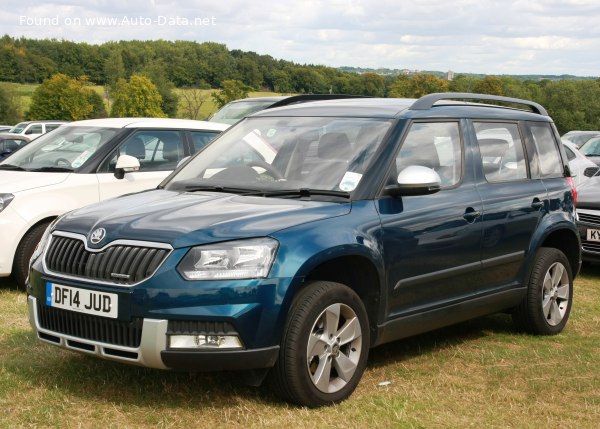
2013 Skoda Yeti (facelift 2013) - Photo 1
Skoda Yeti (facelift 2013) - Photo 2

Key specs

Skoda Yeti (facelift 2013) 2.0 TDI (150 Hp) SCR /SUV 2015 - 2017/
What is the body type of Skoda Yeti (facelift 2013)?
SUV, 5 Doors, 5 Seats
What is the fuel consumption and economy of Skoda Yeti (facelift 2013) 2.0 TDI (150 Hp) SCR?
4.8 l/100 km
49 US mpg
58.9 UK mpg
20.8 km/l
How environmentally friendly is Skoda Yeti 2.0 TDI (150 Hp) SCR?
126 g/km CO2
Euro 6
How fast is 2015 Yeti (facelift 2013) 2.0 TDI (150 Hp) SCR?
199 km/h | 124 mph
0-100 km/h: 9 sec
0-60 mph: 8.6 sec
What is the power output of Skoda Yeti SUV 2015 2.0 TDI (150 Hp) SCR?
150 Hp, 340 Nm
251 lb.-ft.
What is the engine displacement of Skoda Yeti SUV 2015 2.0 TDI (150 Hp) SCR?
2.0 l
1968 cm3
120.09 cu. in.
What is the number of cylinders in 2015 Skoda 2.0 TDI (150 Hp) SCR?
4, Inline
What is the drivetrain of Skoda Yeti (facelift 2013) SUV 2015 2.0 TDI (150 Hp) SCR?
Front wheel drive. ICE. The Internal combustion engine (ICE) drives the front wheels of the vehicle.
What is the length of 2015 Skoda Yeti SUV?
4222 mm
166.22 in.
What is the width of 2015 Skoda Yeti SUV?
1793 mm
70.59 in.
What is the kerb weight of 2015 Skoda Yeti (facelift 2013) 2.0 TDI (150 Hp) SCR?
1411 kg
3111 lbs.
What is the maximum permissible mass of 2015 Skoda Yeti (facelift 2013) 2.0 TDI (150 Hp) SCR?
2031 kg
4478 lbs.
What is the trunk (boot) capacity of 2015 Skoda Yeti SUV?
415 - 1665 l
14.7 - 58.8 cu. ft.
What are the number of gears and the gearbox type of 2015 Skoda Yeti (facelift 2013) 2.0 TDI (150 Hp) SCR?
6, manual transmission

General information

Brand
Model
Modification (Engine)
2.0 TDI (150 Hp) SCR
Start of production
May, 2015
End of production
2017
Powertrain Architecture
Internal Combustion engine
Body type
SUV (Sport Utility Vehicle)
Seats
5
Doors
5
Looking for Skoda Yeti on the used-car market?
Check its history →

Performance specs

Fuel consumption (economy) - urban
5.6 l/100 km 42 US mpg
50.4 UK mpg
17.9 km/l
Fuel consumption (economy) - extra urban
4.3 l/100 km 54.7 US mpg
65.7 UK mpg
23.3 km/l
Fuel consumption (economy) - combined
4.8 l/100 km 49 US mpg
58.9 UK mpg
20.8 km/l
CO2 emissions
126 g/km
Fuel Type
Diesel
Acceleration 0 - 100 km/h
9 sec
Acceleration 0 - 62 mph
9 sec
Acceleration 0 - 60 mph (Calculated by Auto-Data.net)
8.6 sec
Maximum speed
199 km/h 124 mph
Emission standard
Euro 6
Weight-to-power ratio
9.4 kg/Hp, 106.3 Hp/tonne
Weight-to-torque ratio
4.2 kg/Nm, 241 Nm/tonne

Engine specs

Power
150 Hp @ 3500 rpm.
Power per litre
76.2 Hp/l
Torque
340 Nm @ 1750-3000 rpm. 251 lb.-ft. @ 1750-3000 rpm.
Engine layout
Front, Transverse
Engine Model/Code
EA288 / CUUB
Engine displacement
1968 cm3 120.09 cu. in.
Number of cylinders
4
Engine configuration
Inline
Cylinder Bore
81 mm 3.19 in.
Piston Stroke
95.5 mm 3.76 in.
Compression ratio
16.2:1
Number of valves per cylinder
4
Fuel injection system
Diesel Commonrail
Engine aspiration
Turbocharger, Intercooler
Valvetrain
DOHC
Engine oil capacity
4.7 l 4.97 US qt | 4.14 UK qt
Engine oil specification
Coolant
8 l 8.45 US qt | 7.04 UK qt
Engine systems
Particulate filter

Volume and weights

Kerb Weight
1411 kg 3111 lbs.
Max. weight
2031 kg 4478 lbs.
Max load
620 kg 1367 lbs.
Trunk (boot) space - minimum
415 l 14.7 cu. ft.
Trunk (boot) space - maximum
1665 l 58.8 cu. ft.
Fuel tank capacity
55 l 14.53 US gal | 12.1 UK gal
Max. roof load
100 kg 220 lbs.
Permitted trailer load with brakes (12%)
1800 kg 3968 lbs.
Permitted trailer load without brakes
740 kg 1631 lbs.
Permitted towbar download
80 kg 176 lbs.

Dimensions

Length
4222 mm 166.22 in.
Width
1793 mm 70.59 in.
Width including mirrors
1956 mm 77.01 in.
Height
1691 mm 66.57 in.
Wheelbase
2578 mm 101.5 in.
Front track
1541 mm 60.67 in.
Rear (Back) track
1537 mm 60.51 in.
Front overhang
877 mm 34.53 in.
Rear overhang
767 mm 30.2 in.
Ride height (ground clearance)
180 mm 7.09 in.
Drag coefficient (Cd)
0.36
Minimum turning circle (turning diameter)
10.32 m 33.86 ft.
Approach angle
19°
Departure angle
26.7°
Ramp-over (breakover) angle
19.6°
Climb angle
41°

Drivetrain, brakes and suspension specs

Drivetrain Architecture
The Internal combustion engine (ICE) drives the front wheels of the vehicle.
Drive wheel
Front wheel drive
Number of gears and type of gearbox
6 gears, manual transmission
Front suspension
Independent, McPherson type with coil spring and anti-roll bar
Rear suspension
Independent multi-link spring suspension with anti-roll bar
Front brakes
Ventilated discs
Rear brakes
Disc
Assisting systems
ABS (Anti-lock braking system)
Steering type
Steering rack and pinion
Power steering
Electric Steering
Tire size
215/60 R16; 225/50 R17
Wheel rim size
16; 17