Home › Car catalog › Peugeot › 306 › 306 Cabrio (facelift 1997) › 2.0i 16V (133 Hp)

PeugeotPeugeot 306 Cabrio (facelift 1997) 2.0i 16V (133 Hp)1997, 1998, 1999, 2000, 2001, 2002: specs, Fuel consumption, Dimensions

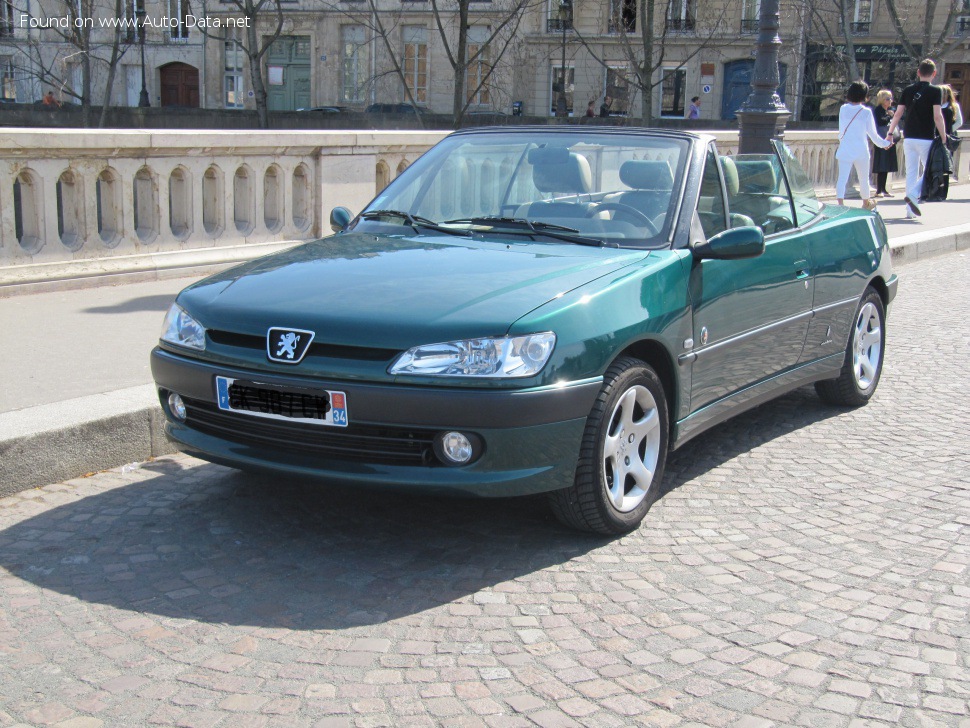
1997 Peugeot 306 Cabrio (facelift 1997) - Photo 1
Peugeot 306 Cabrio (facelift 1997) - Photo 2

Key specs

Peugeot 306 Cabrio (facelift 1997) 2.0i 16V (133 Hp) /Cabriolet 1997 - 2002/
What is the body type of Peugeot 306 Cabrio (facelift 1997)?
Cabriolet, 2 Doors, 4 Seats
What is the fuel consumption and economy of Peugeot 306 Cabrio (facelift 1997) 2.0i 16V (133 Hp)?
9.2 l/100 km
25.6 US mpg
30.7 UK mpg
10.9 km/l
How environmentally friendly is Peugeot 306 2.0i 16V (133 Hp)?
221 g/km CO2
How fast is 1997 306 Cabrio (facelift 1997) 2.0i 16V (133 Hp)?
196 km/h | 122 mph
0-100 km/h: 11.1 sec
0-60 mph: 10.5 sec
What is the power output of Peugeot 306 Cabriolet 1997 2.0i 16V (133 Hp)?
133 Hp, 180 Nm
133 lb.-ft.
What is the engine displacement of Peugeot 306 Cabriolet 1997 2.0i 16V (133 Hp)?
2.0 l
1998 cm3
121.93 cu. in.
What is the number of cylinders in 1997 Peugeot 2.0i 16V (133 Hp)?
4, Inline
What is the drivetrain of Peugeot 306 Cabrio (facelift 1997) Cabriolet 1997 2.0i 16V (133 Hp)?
Front wheel drive. ICE. The Internal combustion engine (ICE) drives the front wheels of the vehicle.
What is the length of 1997 Peugeot 306 Cabriolet?
4179 mm
164.53 in.
What is the width of 1997 Peugeot 306 Cabriolet?
1680 mm
66.14 in.
What is the kerb weight of 1997 Peugeot 306 Cabrio (facelift 1997) 2.0i 16V (133 Hp)?
1270 kg
2800 lbs.
What is the maximum permissible mass of 1997 Peugeot 306 Cabrio (facelift 1997) 2.0i 16V (133 Hp)?
1680 kg
3704 lbs.
What is the trunk (boot) capacity of 1997 Peugeot 306 Cabriolet?
274 l
9.7 cu. ft.
What are the number of gears and the gearbox type of 1997 Peugeot 306 Cabrio (facelift 1997) 2.0i 16V (133 Hp)?
5, manual transmission

General information

Brand
Model
Modification (Engine)
2.0i 16V (133 Hp)
Start of production
1997
End of production
2002
Powertrain Architecture
Internal Combustion engine
Body type
Cabriolet
Seats
4
Doors
2
Looking for Peugeot 306 on the used-car market?
Check its history →

Performance specs

Fuel consumption (economy) - urban
12.9 l/100 km 18.2 US mpg
21.9 UK mpg
7.8 km/l
Fuel consumption (economy) - extra urban
7.1 l/100 km 33.1 US mpg
39.8 UK mpg
14.1 km/l
Fuel consumption (economy) - combined
9.2 l/100 km 25.6 US mpg
30.7 UK mpg
10.9 km/l
CO2 emissions
221 g/km
Fuel Type
Petrol (Gasoline)
Acceleration 0 - 100 km/h
11.1 sec
Acceleration 0 - 62 mph
11.1 sec
Acceleration 0 - 60 mph (Calculated by Auto-Data.net)
10.5 sec
Maximum speed
196 km/h 122 mph
Weight-to-power ratio
9.5 kg/Hp, 104.7 Hp/tonne
Weight-to-torque ratio
7.1 kg/Nm, 141.7 Nm/tonne

Engine specs

Power
133 Hp @ 5500 rpm.
Power per litre
66.6 Hp/l
Torque
180 Nm @ 4200 rpm. 133 lb.-ft. @ 4200 rpm.
Engine layout
Front, Transverse
Engine Model/Code
RFV XU10J4R
Engine displacement
1998 cm3 121.93 cu. in.
Number of cylinders
4
Engine configuration
Inline
Cylinder Bore
86 mm 3.39 in.
Piston Stroke
86 mm 3.39 in.
Compression ratio
10.4:1
Number of valves per cylinder
4
Fuel injection system
Multi-port manifold injection
Engine aspiration
Naturally aspirated engine
Valvetrain
DOHC
Engine oil capacity
4.3 l 4.54 US qt | 3.78 UK qt
Engine oil specification
Coolant
7.5 l 7.93 US qt | 6.6 UK qt

Volume and weights

Kerb Weight
1270 kg 2800 lbs.
Max. weight
1680 kg 3704 lbs.
Max load
410 kg 904 lbs.
Trunk (boot) space - minimum
274 l 9.7 cu. ft.
Fuel tank capacity
60 l 15.85 US gal | 13.2 UK gal
Permitted trailer load with brakes (12%)
1000 kg 2205 lbs.
Permitted trailer load without brakes
670 kg 1477 lbs.

Dimensions

Length
4179 mm 164.53 in.
Width
1680 mm 66.14 in.
Height
1356 mm 53.39 in.
Wheelbase
2540 mm 100 in.
Front track
1454-1465 mm 57.24 - 57.68 in.
Rear (Back) track
1420-1439 mm 55.91 - 56.65 in.
Front overhang
815 mm 32.09 in.
Rear overhang
824 mm 32.44 in.
Ride height (ground clearance)
120 mm 4.72 in.
Drag coefficient (Cd)
0.37
Minimum turning circle (turning diameter)
11.0 m 36.09 ft.

Drivetrain, brakes and suspension specs

Drivetrain Architecture
The Internal combustion engine (ICE) drives the front wheels of the vehicle.
Drive wheel
Front wheel drive
Number of gears and type of gearbox
5 gears, manual transmission
Front suspension
Wishbone
Rear suspension
Trailing arm
Front brakes
Ventilated discs
Rear brakes
Disc
Assisting systems
ABS (Anti-lock braking system)
Steering type
Steering rack and pinion
Power steering
Hydraulic Steering
Tire size
195/55 R15 V
Wheel rim size
15