Home >> Car catalog >> Mitsubishi >> Eclipse >> Eclipse II (2G) >> 2.0 Turbo 16V (213 Hp)
All brands Blog Login Register Car Specs API
English ▼

Specs of Mitsubishi Eclipse II (2G) 2.0 Turbo 16V (213 Hp) /1995, 1996/

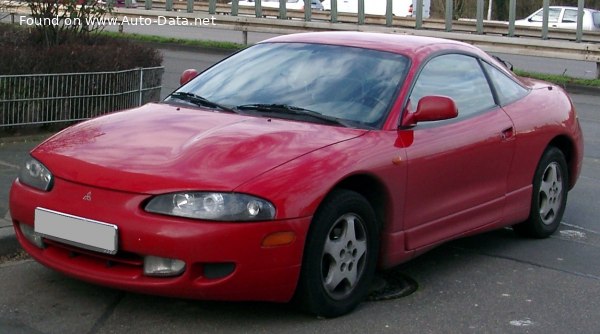
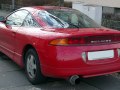
1995 Mitsubishi Eclipse II (2G) - Photo 1
Mitsubishi Eclipse II (2G) - Photo 2Mitsubishi Eclipse II (2G) - Photo 3Mitsubishi Eclipse II (2G) - Photo 4Mitsubishi Eclipse II (2G) - Photo 5

Key specs

Mitsubishi Eclipse II (2G) 2.0 Turbo 16V (213 Hp) /Coupe, Liftback 1995 - 1996/

What is the body type of Mitsubishi Eclipse II (2G)?
Coupe, Liftback, 2 Doors, 4 Seats
What is the fuel consumption and economy of Mitsubishi Eclipse II (2G) 2.0 Turbo 16V (213 Hp)?
9 l/100 km
26.1 US mpg
31.4 UK mpg
11.1 km/l
What is the power output of Mitsubishi Eclipse Coupe, Liftback 1995 2.0 Turbo 16V (213 Hp)?
213 Hp, 290 Nm
214 lb.-ft.
What is the engine displacement of Mitsubishi Eclipse Coupe, Liftback 1995 2.0 Turbo 16V (213 Hp)?
2.0 l
1997 cm3
121.86 cu. in.
What is the number of cylinders in 1995 Mitsubishi 2.0 Turbo 16V (213 Hp)?
4, Inline
What is the drivetrain of Mitsubishi Eclipse II (2G) Coupe, Liftback 1995 2.0 Turbo 16V (213 Hp)?
Front wheel drive. Internal Combustion engine. The Internal combustion engine (ICE) drives the front wheels of the vehicle.
What is the length of 1995 Mitsubishi Eclipse Coupe, Liftback?
4375 mm
172.24 in.
What is the width of 1995 Mitsubishi Eclipse Coupe, Liftback?
1745 mm
68.7 in.
What is the kerb weight of 1995 Mitsubishi Eclipse II (2G) 2.0 Turbo 16V (213 Hp)?
1305 kg
2877 lbs.
What is the maximum permissible mass of 1995 Mitsubishi Eclipse II (2G) 2.0 Turbo 16V (213 Hp)?
1750 kg
3858 lbs.
What are the number of gears and the gearbox type of 1995 Mitsubishi Eclipse II (2G) 2.0 Turbo 16V (213 Hp)?
5, manual transmission
General information

Model
Generation
Modification (Engine)
2.0 Turbo 16V (213 Hp)
Start of production
1995
End of production
1996
Powertrain Architecture
Internal Combustion engine
Body type
Coupe, Liftback
Seats
4
Doors
2
Looking for Mitsubishi Eclipse on the used-car market?
Check its history →

Performance specs

Fuel consumption (economy) - urban
15 l/100 km 15.7 US mpg
18.8 UK mpg
6.7 km/l
Fuel consumption (economy) - extra urban
7.6 l/100 km 30.9 US mpg
37.2 UK mpg
13.2 km/l
Fuel consumption (economy) - combined
9 l/100 km 26.1 US mpg
31.4 UK mpg
11.1 km/l
Fuel Type
Petrol (Gasoline)
Weight-to-power ratio
6.1 kg/Hp, 163.2 Hp/tonne
Weight-to-torque ratio
4.5 kg/Nm, 222.2 Nm/tonne

Engine specs

Power
213 Hp @ 6000 rpm.
Power per litre
106.7 Hp/l
Torque
290 Nm @ 3000 rpm. 214 lb.-ft. @ 3000 rpm.
Engine layout
Front, Transverse
Engine displacement
1997 cm3 121.86 cu. in.
Number of cylinders
4
Engine configuration
Inline
Cylinder Bore
85 mm 3.35 in.
Piston Stroke
88 mm 3.46 in.
Compression ratio
8.5:1
Number of valves per cylinder
4
Fuel injection system
Multi-port manifold injection
Engine aspiration
Turbocharger
Valvetrain
DOHC

Volume and weights

Kerb Weight
1305 kg 2877 lbs.
Max. weight
1750 kg 3858 lbs.
Max load
445 kg 981 lbs.
Fuel tank capacity
64 l 16.91 US gal | 14.08 UK gal

Dimensions

Length
4375 mm 172.24 in.
Width
1745 mm 68.7 in.
Height
1295 mm 50.98 in.
Wheelbase
2510 mm 98.82 in.
Front track
1515 mm 59.65 in.
Rear (Back) track
1510 mm 59.45 in.
Front overhang
930 mm 36.61 in.
Rear overhang
935 mm 36.81 in.
Ride height (ground clearance)
145 mm 5.71 in.
Approach angle
11.5°
Departure angle
15.8°

Drivetrain, brakes and suspension specs

Drivetrain Architecture
The Internal combustion engine (ICE) drives the front wheels of the vehicle.
Drive wheel
Front wheel drive
Number of gears and type of gearbox
5 gears, manual transmission
Front suspension
Independent multi-link suspension
Rear suspension
Independent multi-link suspension
Front brakes
Ventilated discs
Rear brakes
Disc
Assisting systems
ABS (Anti-lock braking system)
Steering type
Steering rack and pinion
Power steering
Hydraulic Steering
Tire size
205/60 R15
Wheel rim size
15