What is the body type of Chrysler Voyager II?
Minivan, 3 Doors, 7 Seats
What is the fuel consumption and economy of Chrysler Voyager II 2.5 i (101 Hp) Automatic?
9.6 l/100 km
24.5 US mpg
29.4 UK mpg
10.4 km/l
How fast is 1990 Voyager II 2.5 i (101 Hp) Automatic?
158 km/h | 98 mph
0-100 km/h: 16 sec
0-60 mph: 15.2 sec
What is the power output of Chrysler Voyager Minivan 1990 2.5 i (101 Hp) Automatic?
101 Hp, 183 Nm
135 lb.-ft.
What is the engine displacement of Chrysler Voyager Minivan 1990 2.5 i (101 Hp) Automatic?
2.5 l
2501 cm3
152.62 cu. in.
What is the number of cylinders in 1990 Chrysler 2.5 i (101 Hp) Automatic?
4, Inline
What is the drivetrain of Chrysler Voyager II Minivan 1990 2.5 i (101 Hp) Automatic?
Front wheel drive. ICE. The Internal combustion engine (ICE) drives the front wheels of the vehicle.
What is the length of 1990 Chrysler Voyager Minivan?
4525 mm
178.15 in.
What is the width of 1990 Chrysler Voyager Minivan?
1830 mm
72.05 in.
What is the kerb weight of 1990 Chrysler Voyager II 2.5 i (101 Hp) Automatic?
1485 kg
3274 lbs.
What is the maximum permissible mass of 1990 Chrysler Voyager II 2.5 i (101 Hp) Automatic?
2395 kg
5280 lbs.
What is the trunk (boot) capacity of 1990 Chrysler Voyager Minivan?
671 - 3250 l
23.7 - 114.8 cu. ft.
What are the number of gears and the gearbox type of 1990 Chrysler Voyager II 2.5 i (101 Hp) Automatic?
3, automatic transmission
 Chrysler Voyager II 2.5 i (101 Hp) Automatic1990, 1991, 1992, 1993, 1994, 1995: specs, Fuel consumption, Dimensions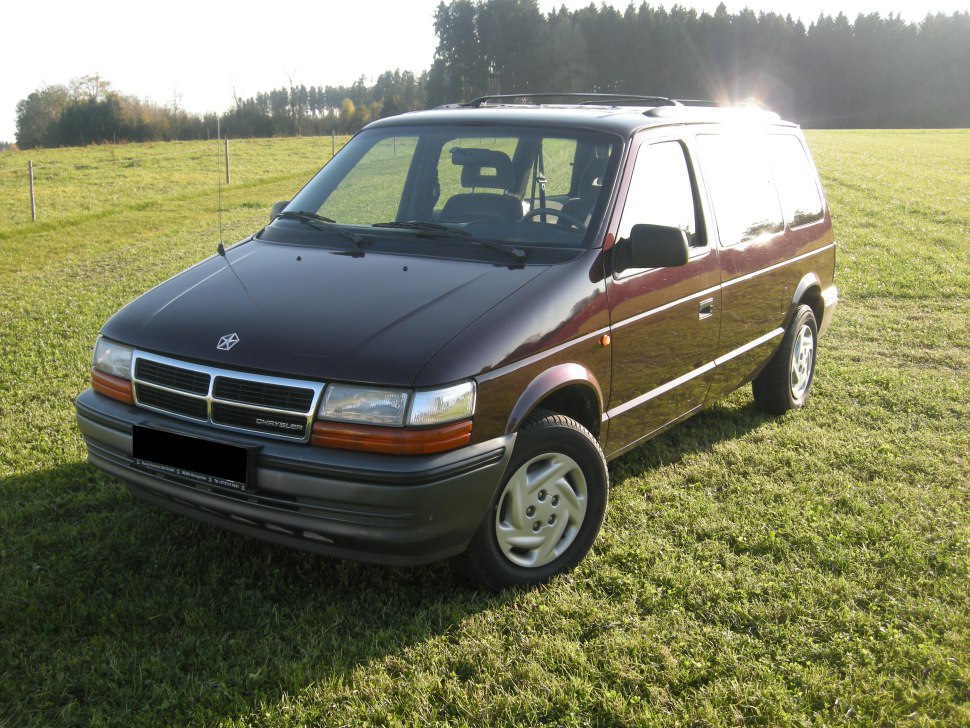
 Български
 English
 Русский
 Deutsch
 Italiano
 Français
 Español
 Ελληνικά
 Türkçe
 Română
 Suomi
Suomi Svenska
 Norsk
Norsk Polski
 Português
 Nederlands
 Čeština
 Magyar
 YouTube
 Telegram
 Viber
Viber Facebook
 Instagram
 TikTok
 Pinterest
