Picture this: a frosty Tuesday morning in November, the road surface barely above zero, and the school-run traffic in front of you grinds to a halt every fifty meters. You brake, the nose dips, the rear settles — and somewhere underneath the car, the suspension is working harder than it ever does on a relaxed motorway cruise in July. That gap between calm summer long-haul driving and punishing urban winter use is exactly where shock absorber condition starts to matter in ways most drivers never consider until something goes wrong.
A shock absorber is, at its core, a hydraulic device. It forces oil through calibrated valves to convert kinetic energy into heat. Cold weather thickens that oil, which raises the internal resistance of the damper and can make the ride feel stiffer during the first few kilometers of a winter commute. This is normal behaviour and not a sign of failure, but it does mean that a unit already worn — with a leaking seal or a bent piston rod — will behave even less predictably at low temperatures than it would in summer. Shock absorbers are available in a wide range of specifications for most common vehicles, and choosing the right type for your typical driving conditions matters as much as simply replacing a failed unit.
Urban driving puts a fundamentally different kind of stress on suspension components compared with steady motorway travel. In city use, the damper cycles continuously: speed bumps, potholed side streets, sharp braking before junctions, and repeated kerb drops when entering car parks. A driver covering forty kilometres a day through a congested city may subject each damper to several hundred full compression-and-rebound cycles, whereas the same distance on a smooth dual carriageway involves far fewer. Summer motorway driving is gentler still — road surfaces are generally better, speed is constant, and thermal expansion keeps the asphalt smoother. The practical consequence is that urban drivers, especially in climates with cold winters and potholed spring roads, tend to exhaust damper service life more quickly than their rural or motorway counterparts.
|
Damper Type |
Best Suited Driving Condition |
Key Characteristic |
Typical Weakness |
|
Twin-tube hydraulic |
Motorway and light suburban use |
Smooth, compliant ride at low cycle rates |
Oil aeration under repeated rapid cycling |
|
Twin-tube gas-assisted |
Mixed urban and rural driving |
Reduced aeration risk, moderate cost |
Slightly firmer than pure hydraulic in cold weather |
|
Monotube gas-pressurised |
Urban stop-start and sport use |
Consistent response under frequent cycling |
Higher road noise transmitted at motorway speeds |
|
Coilover adjustable |
Performance or track-day vehicles |
Ride height and damping fully tunable |
Requires periodic recalibration, higher cost |
Not every damper is identical even within the same vehicle application. Manufacturers offer standard, sport, and comfort variants that differ in valve calibration, stroke length, and sometimes the type of gas charge used. A driver who covers long motorway distances in mild climates may find a comfort-tuned unit perfectly adequate for years. Someone who navigates urban speed bumps in a northern European winter, however, may benefit from a sport-calibrated unit with a more progressive valve characteristic, which resists bottoming out on abrupt impacts while still absorbing small-frequency vibrations from rough city surfaces. Gas-pressurised monotube designs generally resist aeration of the oil better than twin-tube units under repeated rapid cycling — an advantage in stop-start city use — though they tend to transmit more road noise at motorway speeds. The right choice depends on an honest assessment of where and when you drive most.
Shock absorbers do not operate in isolation. The coil spring sets the static ride height and absorbs the first fraction of a compression event before the damper takes over. In winter, springs are exposed to road salt, which accelerates corrosion at the coil ends — a common cause of sudden spring fracture that is frequently misdiagnosed as damper failure. Strut mounts and top bearings transmit force between the damper and the body; worn bearings produce a characteristic clunk on cold mornings and reduce steering precision. Bump stops, the small polyurethane or rubber buffers inside the damper housing, harden with age and temperature, and a cracked bump stop can allow metal-to-metal contact on deep potholes. Inspecting all these components together during a damper replacement is more efficient than addressing them individually across multiple workshop visits.
For drivers comparing replacement options online, the AUTODOC Marketplace is a platform through which selected, vetted third-party suppliers offer their products alongside AUTODOC's own catalogue. This arrangement gives customers a broader product selection and more competitive price points while keeping the purchase within the familiar AUTODOC environment. It is worth knowing the difference between the two seller types: when AUTODOC itself is the seller, AUTODOC handles shipping, invoicing, and customer service directly. When a Marketplace third-party seller fulfils the order, those responsibilities rest with that supplier, though AUTODOC monitors all participating merchants against defined performance metrics. Checking which entity is fulfilling a specific order before completing a purchase helps set the right expectations for delivery times and return procedures.
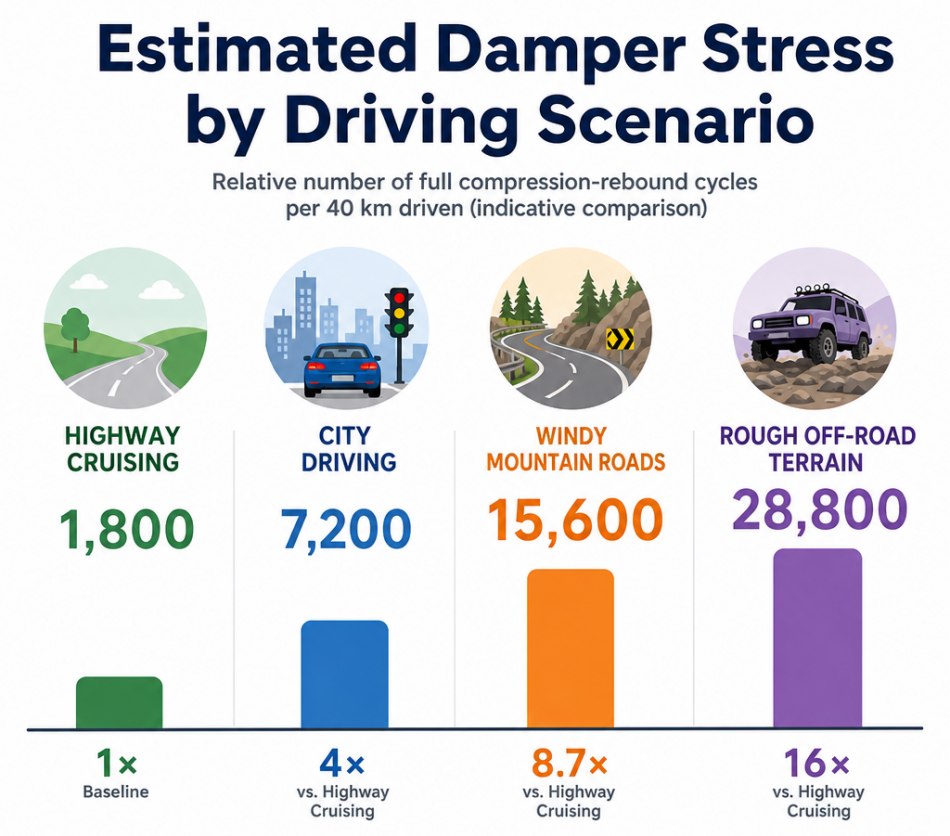
Autumn is the most logical moment to assess suspension condition, precisely because the transition from dry summer roads to wet, cold, and potentially icy surfaces demands the most from every component. A quick visual inspection in good light can reveal oil streaks on the damper body — the clearest sign of a failing seal — as well as corrosion on spring coils and cracked rubber on strut mounts. Bouncing each corner of the car by hand and counting how quickly the body settles is a rough but useful field test: more than one continued oscillation after releasing suggests the damper is no longer adequately controlling rebound. Combining this check with a tyre inspection, a brake fluid moisture test, and a look at wiper condition turns a fifteen-minute exercise into a meaningful pre-winter audit.
Before the first hard frost arrives, take ten minutes to push down on each corner of the car over a firm surface and look for oil residue on the lower damper body. If you find either symptom, book the car in for a full suspension inspection rather than waiting for a tyre-wear pattern or a handling scare to force the issue — catching a failing damper in autumn is significantly less stressful than discovering the problem on a wet, cold motorway in January.


 YouTube
 Telegram
 Viber
Viber Facebook
 Instagram
 TikTok
 Pinterest