Can you read the R34 Skyline GT-R spec sheet without knowing the cars that went before it? You would see numbers, features and famous technology—but you would miss the story. The Nissan Skyline GT-R was not constructed from a single great idea. It became a legend as each generation overcame a challenge the previous one had failed to overcome, and so on. The R32 was the beginning, the R33 was the refinement, and the R34 was the precision. For this reason, this car remains one of the best JDM sports cars ever produced. This guide isn't just about the R34 GT-R specifications; we will delve into the engineering decisions, the Skyline GT-R history, and the development of the iconic RB26DETT engine that transformed a great car into a legend.
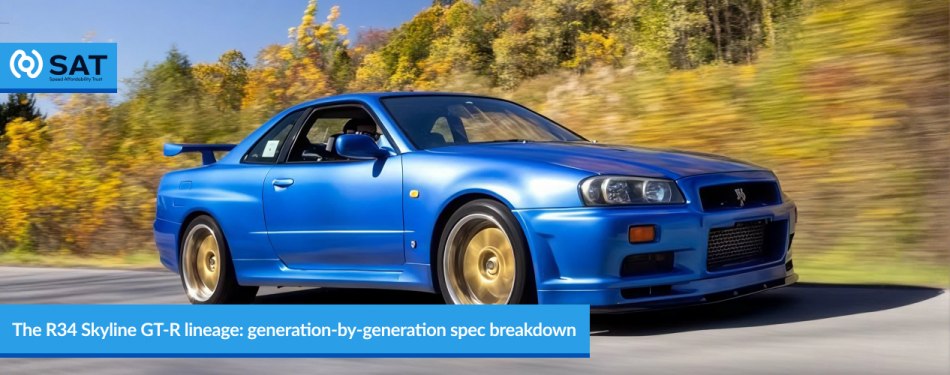
The R34 Skyline GT-R seems to have been Nissan's biggest performance car of its era. The real story is much more fascinating. Each of the bolt, sensor, and suspension modifications is a lesson from previous generations. The all-wheel-drive system and RB26DETT engine proved themselves to be the best on the track, and the R32 did the rest. Rather than just searching for more power, the R33 beefed up the chassis, added enhanced stability, cooling, and driver confidence. Nissan engineers heard from racers, mechanics, and everyday drivers and found hundreds of small things they could upgrade that were not outlined in the spec sheets. The R34 was not a new model, but the fruits of years of careful problem-solving. That patient attitude is what made the Nissan Skyline GT-R a timeless icon.
It's not like the Skyline GT-R family is being discarded every few years, but it's more like a master builder refining a master design. Nor did Nissan simply copy good ideas; it made them even better. That's why one generation feels related to the next. It was not the aim to make the fastest car with the highest numbers. It was to create a machine that would grow in confidence with each entry into a corner, gear change, and accelerator push.
If you look at the GT-R family from start to finish, you can tell that each car was passing on its strongest attributes and rectifying its worst ones. So, that's the essence of the GT-R story, a constant evolution.
|
Generation |
Production Years |
What Nissan Perfected |
Biggest Engineering Challenge Solved |
Lasting Legacy |
|
R32 GT-R (BNR32) |
1989–1994 |
Launched the twin-turbo RB26DETT engine, ATTESA E-TS all-wheel drive, and the Super HICAS four-wheel steering. |
Demonstrated the superiority of advanced technology over more powerful and larger competitors. |
Re-introduced the GT-R as a world-class performance icon and became known as "Godzilla. |
|
R33 GT-R (BCNR33) |
1995–1998 |
Better chassis rigidity, suspension tuning, aerodynamics, cooling, and high-speed stability. |
Made long, demanding drives easier without affecting performance. |
Demonstrated that balance, durability, and driver confidence are also important factors in determining true performance. |
|
R34 GT-R (BNR34) |
1999–2002 |
Fusion of proven mechanical systems, smarter electronics, a Getrag 6-speed gearbox and a driver-centric cockpit. |
A combination of race-inspired tech and practicality that many sports cars hadn't yet seen. |
Established as the most popular Skyline GT-R, known for its accuracy, tunability, and classic styling. |
The key takeaway from this family tree is easy to overlook. The R34 wasn't a legendary car because it forgot what it once was. It became legendary because it respected it. Each generation of Nissan has been treated as a chapter in the same engineering notebook, continuing all the good ideas while discreetly refining all the faults. That patient attitude is what has made the Skyline GT-R one of the clearest examples of how continuous improvement can turn an automotive icon rather than just a fast car.
The return of the Nissan Skyline GT-R in 1989 was not one in which Nissan was attempting to create the fastest roadster in the world. It was building a car that would steadily accelerate lap by lap without losing control. That was the most basic objective that dictated all of that. The legendary RB26DETT engine was created to be strong enough to fight hard racing, and the ATTESA E-TS all-wheel-drive system was engineered to deliver power where it mattered most, not where it didn't. Nissan also introduced four-wheel steering with Super HICAS for enhanced confidence in corners. Its official strength, based on a paper agreement made at the time by Japan's industries, seemed rather limited, but it was not.
The greatest benefit, however, was the R32's impact on the way engineers think about speed. Instead of relying on one powerful feature, it built a lot of smart systems. This engineering philosophy formed the backbone of the Skyline GT-R's legacy, setting the tone for all subsequent iconic models, such as the iconic R34 Skyline GT-R.
The R33, often described as the heavier version of the R32, is one of Nissan's ingenious engineering choices. Nissan did not seek to be lighter on the air for magazine headlines, but rather on the driver's back. The chassis was sturdier, the suspension absorbed rough roads better, and the cooling systems handled long, hard drives with greater confidence. The longer wheelbase also helped to give the car a more stable ride at high speeds without diminishing its thrill. These changes did not have to make a good impression on a short test drive, but they do on the race track or hours behind the wheel.
The R33 proved that for Nissan, perfection isn't the goal; it's consistency. Those lessons were the hidden link between the early skyline GT-Rs and the more focused and refined R34 skyline GT-R, and, in that sense, greatness is achieved through small bolt-on changes, not big redesigns.
The R34 Skyline GT-R wasn't an attempt to redefine the GT-R game. It instead honed each and every crucial point until the car functioned as a single entity. But Nissan reduced the wheelbase compared to its predecessor, the R33, to make the car feel faster and more responsive in corners, while retaining the stability features they had relied on. A legendary engine, the RB26DETT, remained the power source, but the power was now better controlled by a stronger Getrag 6-speed manual transmission.
A major improvement was the driver-oriented cockpit. The new Multi-Function Display presented live performance data, enabling drivers to understand the car's behavior rather than just guessing. The R34 GT-R specs are not just for showroom appeal; they were also to help establish a better bond between the driver and the machine. This is one of the reasons why the R34 remains timeless even today. It rewarded skill, gave people confidence, and illustrated that it's not about horsepower alone. It's all about perfect teamwork between engineering and the driver.
The best thing the Skyline GT-R has done in its history was not to increase the power every couple of years. It was truly making all key systems smarter, stronger, and more driver-trustworthy. Rather than dismissing successful ideas, Nissan worked to make them more effective. The following timeline outlines the small changes over three generations that led to one of the most well-known JDM sports cars of all time.
|
Engineering Area |
R32 GT-R |
R33 GT-R |
R34 Skyline GT-R |
|
Design Goal |
Win races through advanced technology |
Improve balance and stability |
Create the ultimate driver-focused GT-R |
|
RB26DETT Engine |
Strong twin-turbo foundation |
Better cooling and durability |
Sharper response with improved reliability |
|
ATTESA AWD System |
Intelligent torque distribution introduced |
Faster and smoother power transfer |
More refined control with quicker reactions |
|
Steering Feel |
Sharp but demanding |
More stable at high speed |
Faster, more precise, and confidence-inspiring |
|
Suspension |
Track-focused setup |
Better ride comfort without losing grip |
Balanced for both road and circuit driving |
|
Transmission |
5-speed manual |
Improved 5-speed durability |
Strong Getrag 6-speed manual gearbox |
|
Driver Technology |
Traditional analog gauges |
Better onboard monitoring |
Multi-Function Display with live performance data |
|
Chassis Character |
Raw and aggressive |
Stronger and more forgiving |
Compact, rigid, and highly responsive |
|
Engineering Philosophy |
Build a champion |
Build consistency |
Perfect every proven idea |
It's impossible not to notice the pattern. Nissan was never seeking to sell the idea of a radical change for the sake of marketing. Each generation addressed one of the weaknesses and preserved the strengths. It is this quiet discipline that made the R34 Skyline GT-R one of the best models in the Skyline family, rather than another new addition.
People will recall the RB26DETT engine for its ability to produce power. This is just 50% of the truth. The true evolution of it was gaining the trust of drivers. Nissan weren't just adding more power from one model to the next. The job of the engineers was to keep the engine settling into its pressure, to allow it to produce smoother power and to withstand repeated hard driving. This quiet reliability allowed the tuners to play with it well beyond the limits of the factory settings. The confidence the engine inspired was its greatest asset, not the power it generated on the dyno. Long before any changes were made, Nissan had already created an engine that had faith in the performance of tomorrow.
Not all of the GT-R's biggest improvements were necessarily contained on the spec sheet. They fell on the steering wheel, pedals, and the driver's seat. The R32 requested that you honor it. The R33 made you feel relaxed and more comfortable in the car. The R34 Skyline GT-R appeared to know exactly what the driver was thinking before the next corner. All controls were more natural, and there was less hesitation and more confidence for every mile. This is what many numbers fail to describe. It's not the sports car that makes you work harder; it's the sports car that makes you work better without realizing it.
The R34 Skyline GT-R was never recognized as a star for its longevity. The R34 was still the subject of conversation as faster vehicles came in. The reason was simple—it gave an entire generation something to dream about. It was used in racing, in cinema, in video games, in garages where enthusiasts spent their weekends learning instead of driving. Rather than a racecar, the R34 was seen as a car of patience, skill, and passion. There are lots of record-breaking vehicles, but few are changing car culture. It was the R34 that sparked people's interest in engineering, the construction of project cars, and eventually the world of JDM sports cars. Its greatest victory is that enduring impact.
The R34 Skyline GT-R was no lucky success. The fruits of many years of careful learning, testing, and improvement. Each generation addressed a problem, and all of those incremental gains produced one of the most admired performance cars ever made. That's why the R34 remains a favorite long after it left the assembly line. It's a reminder that it's not about cutting corners; it's about moving forward and making progress to achieve your goals. SAT Japan can help you achieve this dream by providing you with authentic Japanese vehicles directly from Japan. The R34's most important thing learned is that greatness is never conceived in a single instant; it is created one improvement at a time.
1. Why is the R34 Skyline GT-R considered more special than earlier GT-R models?
The R34 Skyline GT-R incorporated the best elements of the R32 and R33 while adding new technology, improved handling, and driver-centric features, resulting in the most advanced Skyline GT-R of its era.
2. What engine does the R34 Skyline GT-R use?
The power comes from the legendary 2.6-liter twin-turbocharged RB26DETT, known for its tuning capabilities, racing heritage, and durability.
3. What makes the R34 GT-R different from the R33 GT-R?
The R34 featured a new, shorter and stiffer chassis, a Getrag 6-speed manual transmission, and a reworked all-wheel drive system called ATTESA that delivered better performance.
4. When was the R34 Skyline GT-R produced?
The BNR34 Skyline GT-R was manufactured between January 1999 and August 2002, forming the final GT-R before the introduction of the stand-alone R35 GT-R.
5. Why does the R34 Skyline GT-R remain so valuable today?
The limited production, motorsport achievements, timeless design, exceptional engineering, and lasting effect on global car culture ensure that the R34 remains one of the most covetable JDM sports cars ever created.


 YouTube
 Telegram
 Viber
Viber Facebook
 Instagram
 TikTok
 Pinterest