Home › Car catalog › Compare

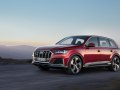
CompareAudi Q7 II (Typ 4M, facelift 2019) 50 TDI V6 (286 Hp) Mild Hybrid quattro tiptronic

Audi Q7 II (Typ 4M, facelift 2019)Audi Q7 II (Typ 4M, facelift 2019) 50 TDI V6 (286 Hp) Mild Hybrid quattro tiptronic

General information

Brand
Audi
Model
Q7
Generation
Q7 II (Typ 4M, facelift 2019)
Modification (Engine)
50 TDI V6 (286 Hp) Mild Hybrid quattro tiptronic
Start of production
October, 2020
End of production
2023
Powertrain Architecture
MHEV (Mild Hybrid Electric Vehicle, power-assist hybrid, battery-assisted hybrid vehicles, BAHV)
Body type
SUV (Sport Utility Vehicle)
Seats
5
Doors
5

Performance specs

Combined fuel consumption (WLTP)
7.8-8.5 l/100 km
CO2 emissions (WLTP)
204-224 g/km
Fuel consumption (economy) - urban
8.7-8.8 l/100 km (NEDC, WLTP equivalent)
Fuel consumption (economy) - extra urban
5.9-6.2 l/100 km (NEDC, WLTP equivalent)
Fuel consumption (economy) - combined
6.9-7.1 l/100 km (NEDC, WLTP equivalent)
CO2 emissions
182-188 g/km (NEDC, WLTP equivalent)
Fuel Type
Diesel
Acceleration 0 - 100 km/h
6.1 sec
Acceleration 0 - 62 mph
6.1 sec
Acceleration 0 - 60 mph
5.8 sec (Calculated by Auto-Data.net)
Maximum speed
241 km/h
Emission standard
Euro 6d-ISC-FCM
Weight-to-power ratio
7.3 kg/Hp, 136.2 Hp/tonne
Weight-to-torque ratio
3.5 kg/Nm, 285.7 Nm/tonne

Electric and hybrid car specs

Gross battery capacity
0.5 kWh
Battery voltage
48 V
Battery technology
Lithium-ion (Li-Ion)
Battery location
Under the trunk
Recuperation output
8 kW

Internal combustion engine specs

Power
286 Hp @ 3500-4000 rpm.
Power per litre
96.4 Hp/l
Torque
600 Nm @ 1750-3250 rpm.
Engine layout
Front, Longitudinal
Engine Model/Code
DPXA
Engine displacement
2967 cm3
Number of cylinders
6
Engine configuration
V-engine
Cylinder Bore
83 mm
Piston Stroke
91.4 mm
Compression ratio
16
Number of valves per cylinder
4
Fuel injection system
Diesel Commonrail
Engine aspiration
Turbocharger, Intercooler
Valvetrain
DOHC
Engine oil capacity
6.1 l
Engine oil specification
Coolant
16.9 l
Engine systems
Start & Stop System
Particulate filter

Volume and weights

Kerb Weight
2100 kg
Max. weight
2830 kg
Max load
730 kg
Trunk (boot) space - minimum
865 l
Trunk (boot) space - maximum
2050 l
Fuel tank capacity
75 l
AdBlue tank
24 l
Max. roof load
100 kg
Permitted trailer load with brakes (8%)
2700 kg
Permitted trailer load with brakes (12%)
2700 kg
Permitted trailer load without brakes
750 kg
Permitted towbar download
115 kg

Dimensions

Length
5063 mm
Width
1970 mm
Width including mirrors
2212 mm
Height
1741 mm
Wheelbase
2995 mm
Front track
1679 mm
Rear (Back) track
1690 mm
Front overhang
977 mm
Rear overhang
1092 mm
Drag coefficient (Cd)
0.32
Minimum turning circle (turning diameter)
12.5 m
Approach angle
23.8°
Departure angle
15.6°

Drivetrain, brakes and suspension specs

Drivetrain Architecture
The Internal combustion engine (ICE) and the electric motor permanently drive the four wheels of the car with the ability to work only in mixed mode.
Drive wheel
All wheel drive (4x4)
Number of gears and type of gearbox
8 gears, automatic transmission tiptronic
Front suspension
Independent multi-link suspension, Air suspension - optional
Rear suspension
Independent multi-link suspension, Air suspension - optional
Front brakes
Ventilated discs, 350 mm
Rear brakes
Ventilated discs, 330 mm
Assisting systems
ABS (Anti-lock braking system)
Steering type
Steering rack and pinion
Power steering
Electric Steering
Tire size
255/60 R18; 255/55 R19; 285/45 R20; 285/40 R21; 285/35 R22
Wheel rim size
8J x 18; 8.5J x 19; 9J x 20; 9.5J x 21; 10J x 22