Home › Car catalog › Compare

CompareHyundai i30 I 2.0 (143 Hp) Automatic

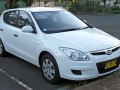
Hyundai i30 IHyundai i30 I 2.0 (143 Hp) Automatic

General information

Brand
Hyundai
Model
i30
Generation
i30 I
Modification (Engine)
2.0 (143 Hp) Automatic
Start of production
2007
End of production
2010
Powertrain Architecture
Internal Combustion engine
Body type
Hatchback
Seats
5
Doors
5

Performance specs

Fuel consumption (economy) - urban
10.3 l/100 km
Fuel consumption (economy) - extra urban
6.1 l/100 km
Fuel consumption (economy) - combined
7.6 l/100 km
Fuel Type
Petrol (Gasoline)
Acceleration 0 - 100 km/h
10.6 sec
Acceleration 0 - 62 mph
10.6 sec
Acceleration 0 - 60 mph
10.1 sec (Calculated by Auto-Data.net)
Maximum speed
195 km/h
Emission standard
Euro 4
Weight-to-power ratio
9.4 kg/Hp, 106.6 Hp/tonne
Weight-to-torque ratio
7.2 kg/Nm, 138.6 Nm/tonne
Internal combustion engine specs

Power
143 Hp @ 6000 rpm.
Power per litre
72.4 Hp/l
Torque
186 Nm @ 4500 rpm.
Engine layout
Front, Transverse
Engine Model/Code
G4GC
Engine displacement
1975 cm3
Number of cylinders
4
Engine configuration
Inline
Cylinder Bore
82 mm
Piston Stroke
93.5 mm
Compression ratio
10
Number of valves per cylinder
4
Fuel injection system
Multi-port manifold injection
Engine aspiration
Naturally aspirated engine
Valvetrain
DOHC
Engine oil capacity
4 l
Engine oil specification
Coolant
6.6 l

Volume and weights

Kerb Weight
1342 kg
Max. weight
1790 kg
Max load
448 kg
Trunk (boot) space - minimum
340 l
Trunk (boot) space - maximum
1200 l
Fuel tank capacity
53 l

Dimensions

Length
4245 mm
Width
1775 mm
Height
1480 mm
Wheelbase
2650 mm

Drivetrain, brakes and suspension specs

Drivetrain Architecture
The Internal combustion engine (ICE) drives the front wheels of the vehicle.
Drive wheel
Front wheel drive
Number of gears and type of gearbox
4 gears, automatic transmission
Front brakes
Ventilated discs
Rear brakes
Disc
Assisting systems
ABS (Anti-lock braking system)
Tire size
205/55 R15
Wheel rim size
15
