Startseite >> Autokatalog >> Toyota >> Progres >> Progres >> 3.0 i 24V (215 PS)
Autokatalog Blog Einloggen Registrierung Car Specs API
Deutsch ▼

Technische Daten Toyota Progres 3.0 i 24V (215 PS) /1998, 1999, 2000, 2001, 2002, 2003, 2004, 2005, 2006, 2007/

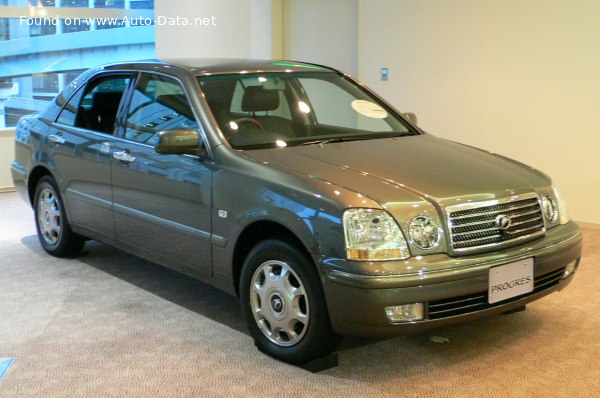
1998 Toyota Progres - Bild 1
Toyota Progres - Bild 2

Hauptspezifikationen:
Toyota Progres 3.0 i 24V (215 PS)
/Limousine 1998 - 2007/

Was ist der Karosserietyp von Toyota Progres?Limousine, 4 Türen, 5 Sitze
Wie schnell ist 1998 Progres 3.0 i 24V (215 Hp)?180 km/h | 111.85 mph
Wie hoch ist die Motorleistung von Toyota Progres Limousine 1998 3.0 i 24V (215 Hp)?215 PS, 294 Nm
216.84 lb.-ft.
Wie groß ist der Hubraum von Toyota Progres Limousine 1998 3.0 i 24V (215 Hp)?3.0 l
2997 cm3
182.89 cu. in.
Wie viele Zylinder hat der Motor von 1998 Toyota 3.0 i 24V (215 Hp)?6, Reihenmotor
Was ist die Antriebsart von Toyota Progres Limousine 1998 3.0 i 24V (215 Hp)?Hinterradantrieb. Verbrennungskraftmaschine. Die VKM treibt die Hinterräder des Fahrzeugs an.
Wie lang ist 1998 Toyota Progres Limousine?4510 mm
177.56 in.
Wie breit ist 1998 Toyota Progres Limousine?1700 mm
66.93 in.
Wie hoch ist das Leergewicht von 1998 Toyota Progres 3.0 i 24V (215 Hp)?1520 kg
3351.03 lbs.
Wie hoch ist die maximal zulässige Gesamtmasse von 1998 Toyota Progres 3.0 i 24V (215 Hp)?1795 kg
3957.3 lbs.
Wie groß ist das Kofferraumvolumen von 1998 Toyota Progres Limousine?420 l
14.83 cu. ft.
Wie viele Gänge hat das Getriebe von Was ist der Getriebetyp von 1998 Toyota Progres 3.0 i 24V (215 Hp)?4, Automatikgetriebe

Toyota Progres 3.0 i 24V (215 PS) - Vollständige Spezifikationen

Allgemeine Informationen

Marke Toyota
Modell Progres
Generation Progres
Modifikation (Motor) 3.0 i 24V (215 PS)
Produktionsbeginn 1998 Jahr
Produktionsende 2007 Jahr
Antriebsstrangarchitektur Verbrennungskraftmaschine
KarosserieLimousine
Sitze 5
Türen 4

Leistung

Verbrauch - Innerorts 14 l/100 km 16.8 US mpg
20.2 UK mpg
7.1 km/l
Verbrauch - Außerorts 9 l/100 km 26.1 US mpg
31.4 UK mpg
11.1 km/l
Kraftstoffart Benzin
Höchstgeschwindigkeit 180 km/h 111.85 mph
Masse-Leistungs-Verhältnis (Leistungsgewicht) 7.1 kg/PS, 141.4 PS/Tonne
Masse-Drehmoment-Verhältnis 5.2 kg/Nm, 193.4 Nm/Tonne

Motor

Max. Motorleistung 215 PS @ 5800 U/min
Leistung pro Liter Hubvolumen 71.7 PS/l
Max. Drehmoment 294 Nm @ 3800 U/min 216.84 lb.-ft. @ 3800 U/min
Motorlayout Front, Längsrichtung
Hubraum 2997 cm3 182.89 cu. in.
Anzahl der Zylinder 6
Motorkonfiguration Reihenmotor
Bohrung 86 mm 3.39 in.
Hub 86 mm 3.39 in.
Verdichtungsverhältnis 10.5:1
Anzahl der Ventile pro Zylinder 4
Kraftstoffeinspritzsystem Mehrpunkt-Saugrohreinspritzung
Motoraufladung Saugmotor
Ventilsteuerung DOHC

Volumen und Gewichte

Leergewicht 1520 kg 3351.03 lbs.
Zul. Gesamtgewicht 1795 kg 3957.3 lbs.
Höchstzulässige Nutzlast 275 kg 606.27 lbs.
Kofferraumvolumen Min. 420 l 14.83 cu. ft.
Tankinhalt 70 l 18.49 US gal | 15.4 UK gal

Maße

Länge 4510 mm 177.56 in.
Breite 1700 mm 66.93 in.
Höhe 1435 mm 56.5 in.
Radstand 2780 mm 109.45 in.
Spur vorne 1475 mm 58.07 in.
Spur hinten 1460 mm 57.48 in.

Antrieb, Bremsen und Federung

Antriebskonzept Die VKM treibt die Hinterräder des Fahrzeugs an.
Antriebsart Hinterradantrieb
Anzahl der Gänge und Art des Getriebes 4 Gänge, Automatikgetriebe
Vorderradaufhängung Doppelquerlenker
Hinterradaufhängung Doppelquerlenker
Bremsen vorne Belüftete Scheibenbremse
Bremsen hinten Scheibenbremse
AssistenzsystemeABS (Antiblockiersystem)
Lenkungstyp Lenkgetriebe
Servolenkung Servolenkung
Reifengröße 195/65 R15