Startseite › Autokatalog › Ford › Escape › Escape IV (Modellpflege 2023) › 2.5 (192 PS) Hybrid eCVT

FordFord Escape IV (Modellpflege 2023) 2.5 (192 PS) Hybrid eCVT2023, 2024, 2025, 2026: Spezifikationen, Verbrauch, Batterie, Elektrische Reichweite, Maße

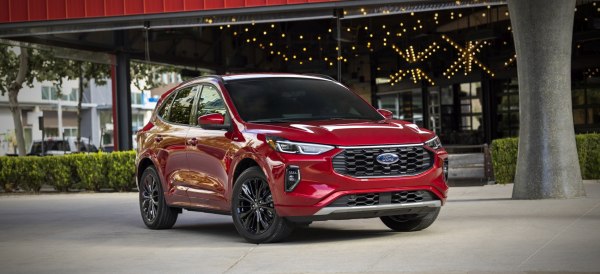
2023 Ford Escape IV (Modellpflege 2023) - Bild 1
Ford Escape IV (Modellpflege 2023) - Bild 2Ford Escape IV (Modellpflege 2023) - Bild 3Ford Escape IV (Modellpflege 2023) - Bild 4Ford Escape IV (Modellpflege 2023) - Bild 5Ford Escape IV (Modellpflege 2023) - Bild 6Ford Escape IV (Modellpflege 2023) - Bild 7Ford Escape IV (Modellpflege 2023) - Bild 8Ford Escape IV (Modellpflege 2023) - Bild 9Ford Escape IV (Modellpflege 2023) - Bild 10

Hauptspezifikationen

Ford Escape IV (Modellpflege 2023) 2.5 (192 PS) Hybrid eCVT /SUV 2023 - /
Was ist der Karosserietyp von Ford Escape IV (Modellpflege 2023)?
SUV, 5 Türen, 5 Sitze
Wie hoch ist die Motorleistung von Ford Escape SUV 2023 2.5 (192 Hp) Hybrid eCVT?
192 PS, 210 Nm
155 lb.-ft.
Wie groß ist der Hubraum von Ford Escape SUV 2023 2.5 (192 Hp) Hybrid eCVT?
2.5 l
2490 cm3
151.95 cu. in.
Wie viele Zylinder hat der Motor von 2023 Ford 2.5 (192 Hp) Hybrid eCVT?
4, Reihenmotor
Was ist die Antriebsart von Ford Escape IV (Modellpflege 2023) SUV 2023 2.5 (192 Hp) Hybrid eCVT?
Vorderradantrieb. FHEV. Die VKM und ein Elektromotor treiben die Vorderräder des Autos an, das im vollelektrischen oder gemischten Modus laufen kann.
Wie lang ist 2023 Ford Escape SUV?
4575 mm
180.12 in.
Wie breit ist 2023 Ford Escape SUV?
1882 mm
74.09 in.
Wie hoch ist das Leergewicht von 2023 Ford Escape IV (Modellpflege 2023) 2.5 (192 Hp) Hybrid eCVT?
1596 kg
3519 lbs.
Wie groß ist das Kofferraumvolumen von 2023 Ford Escape SUV?
974 - 1722 l
34.4 - 60.8 cu. ft.
Wie viele Gänge und welchen Getriebetyp hat 2023 Ford Escape IV (Modellpflege 2023) 2.5 (192 Hp) Hybrid eCVT?
Automatikgetriebe eCVT

Allgemeine Informationen

Marke
Modell
Modifikation (Motor)
2.5 (192 PS) Hybrid eCVT
Produktionsbeginn
2023
Antriebsstrangarchitektur
FHEV (Vollhybrid-Elektrofahrzeug)
Karosserie
SUV (Sportliches Mehrzweckfahrzeug)
Sitze
5
Türen
5
Interessiert an Ford Escape als Gebrauchtwagen?
Fahrzeughistorie prüfen →

Leistung

Kraftstoffart
Benzin
Masse-Leistungs-Verhältnis (Leistungsgewicht)
8.3 kg/PS, 120.3 PS/t
Masse-Drehmoment-Verhältnis
7.6 kg/Nm, 131.6 Nm/t

Elektroautos und Hybridfahrzeuge

Batterietechnologie
Lithium-Ionen (Li-Ion)
Batteriestandort
Unter dem Boden, unter den Rücksitzen

Elektromotor 1

Leistung des Elektromotors
128 PS
Systemleistung
192 PS

Verbrennungsmotor

Max. Motorleistung
163 PS @ 6250 U/min
Leistung pro Liter Hubvolumen
65.5 PS/l
Max. Drehmoment
210 Nm @ 4500 U/min 155 lb.-ft. @ 4500 U/min
Motorlayout
Front, quer
Hubraum
2490 cm3 151.95 cu. in.
Anzahl der Zylinder
4
Motorkonfiguration
Reihenmotor
Bohrung
88.9 mm 3.5 in.
Hub
100.08 mm 3.94 in.
Verdichtungsverhältnis
13:1
Anzahl der Ventile pro Zylinder
4
Kraftstoffeinspritzsystem
Mehrpunkt-Saugrohreinspritzung
Motoraufladung
Saugmotor
Ventilsteuerung
DOHC, iVCT
Motorölfüllmenge
5.4 l 5.71 US qt | 4.75 UK qt
Motorölspezifikation
Kühlmittel
9.1 l 9.62 US qt | 8.01 UK qt

Volumen und Gewichte

Leergewicht
1596 kg 3519 lbs.
Kofferraumvolumen Min.
974 l 34.4 cu. ft.
Kofferraumvolumen Max.
1722 l 60.8 cu. ft.
Tankinhalt
53.7 l 14.19 US gal | 11.81 UK gal
Zul. Anhängerlast gebremst bei 12% Steigung
680 kg 1499 lbs.

Maße

Länge
4575 mm 180.12 in.
Breite
1882 mm 74.09 in.
Breite bei eingeklappten Außenspiegeln
1999 mm 78.7 in.
Breite mit Außenspiegeln
2174 mm 85.59 in.
Höhe
1679 mm 66.1 in.
Radstand
2710 mm 106.69 in.
Spur vorne
1585 mm 62.4 in.
Spur hinten
1570 mm 61.81 in.

Antrieb, Bremsen und Federung

Antriebskonzept
Die VKM und ein Elektromotor treiben die Vorderräder des Autos an, das im vollelektrischen oder gemischten Modus laufen kann.
Antriebsart
Vorderradantrieb
Anzahl der Gänge und Art des Getriebes
Automatikgetriebe eCVT
Vorderradaufhängung
Unabhängige McPherson-Achse mit Schraubenfeder und Stabilisator
Hinterradaufhängung
Unabhängige Mehrlenkerfederung mit Stabilisator
Bremsen vorne
Scheibenbremse
Bremsen hinten
Scheibenbremse
Assistenzsysteme
ABS (Antiblockiersystem)
Lenkungstyp
Zahnstangenlenkung
Servolenkung
Elektrische Servolenkung
Reifengröße